
How to Check Criminal History in Louisville
A Louisville criminal record check works best in five stages. Each stage answers a different question, so keep the report, booking, and case numbers found along the way. A name alone can produce uncertain matches, while a known date, location, or number helps the proper Louisville records custodian find the event.
- Start with Louisville Metro Police Department for an incident or arrest report created by LMPD. Use its routine copy service when the report type and key identifiers are known.
- Use Metro NextRequest for a formal open-records request, older material, or a record that the routine service does not provide. Name LMPD as the agency and describe the existing record precisely.
- Check Louisville Metro Corrections for current or recent custody. Call inmate information when the dynamic search does not load or a release has changed visibility.
- Search Jefferson District or Circuit Court through Guest CourtNet, then request the official order, pleading, or docket from the Circuit Court Clerk.
- Use AOC FastCheck for covered cases statewide or KSP's subject-review process when reviewing one's own fingerprint-supported Kentucky history.
No one channel proves the full Louisville criminal history. An arrest charge can change before filing, and a booking can disappear from a current roster while the police report and court case remain.
Louisville Criminal Record Custodians
The 2003 city-county merger did not merge every record keeper. LMPD creates most Louisville police incident and arrest reports. Louisville Metro Corrections creates jail intake and custody records. The Jefferson Circuit Court Clerk keeps District and Circuit case files. The sheriff mainly handles court security, process, warrants, and related duties rather than serving as Louisville's main patrol-report office.
This distinction prevents a common Louisville records mistake. Sending an LMPD incident request to the sheriff, or asking LMPD for an LMDC booking file, can add delay. Identify who made the record before choosing the portal. Independent home-rule cities inside Jefferson County also retain police departments, so an event described as occurring in “Louisville” may still belong to another agency if it fell within that city's jurisdiction.
The Louisville Police Department
LMPD's official report-copy service handles routine accident and incident reports through GovTransfer, which requires a free account. LMPD Records Management is at 701 West Ormsby Avenue, Suite 001 in the basement, Louisville, KY 40203. The records phone is 502-574-6857, and published counter hours are weekdays from 8 a.m. to 4 p.m.
An accident search uses the report number, report date, and driver or owner surname. An incident search uses the victim surname, report number, and report date. Accident reports cost $10, while incident reports cost $2. The stated response range is usually 24 to 72 hours. Access limits still apply. Crash reports are restricted to listed parties with identification, listed insurer representatives, or attorneys, and some incident reports also require involved-party identification.
When a Louisville report number is unknown, the research identifies two direct email routes: LMPDAccidentReport@louisvilleky.gov for crashes and LMPDIncidentReport@louisvilleky.gov for incidents. Give the date, place, involved-party details allowed by policy, and report type. A routine Louisville copy request should stay in GovTransfer, while a broad request for existing agency material belongs in NextRequest. LMPD's verified mobile app also links report filing, tips, crime maps and data, open records, contacts, and division details. It does not advertise an app-only inmate, warrant, or registry search. That limit matters because a Louisville police app cannot replace LMDC custody data or a Jefferson court docket.
The official Louisville report service appears below without showing a private record.
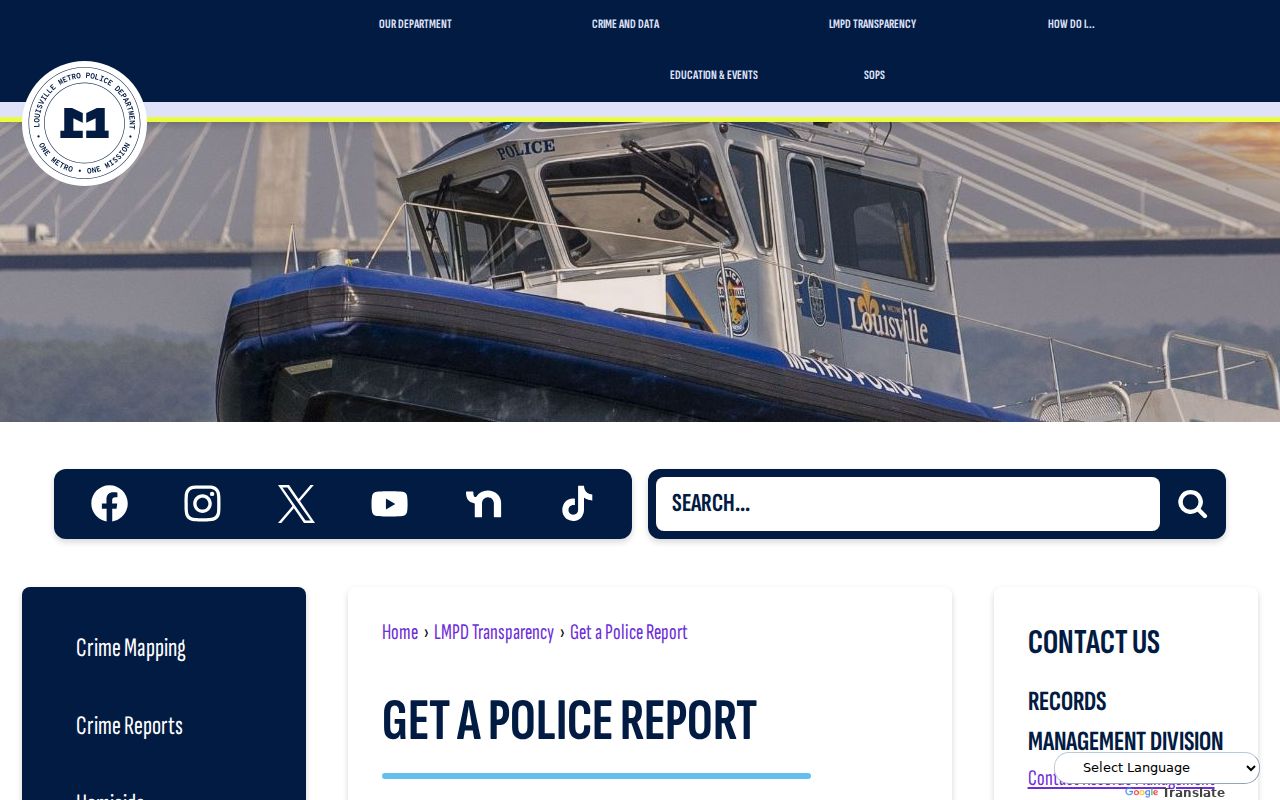
The image reinforces that a Louisville police report request needs report-specific facts, not just a broad name search.
Louisville Criminal Records in NextRequest
Routine copies should start with GovTransfer. A formal request belongs in Louisville Metro's open-records channel when the routine service fails, an older record is needed, or the request involves another executive agency. Select the likely department and give the record type, incident or case number, date range, location, and desired format.
The request form asks for the agency, requester name, contact and address details, email, record description, and sometimes a date range, delivery preference, phone, or attachment. Kentucky's five-business-day rule is a response deadline. It does not promise that a large or heavily redacted Louisville record will be produced within five days. Ask for a fee estimate before requesting extensive video or a large volume.
The official Metro open-records source is pictured below.
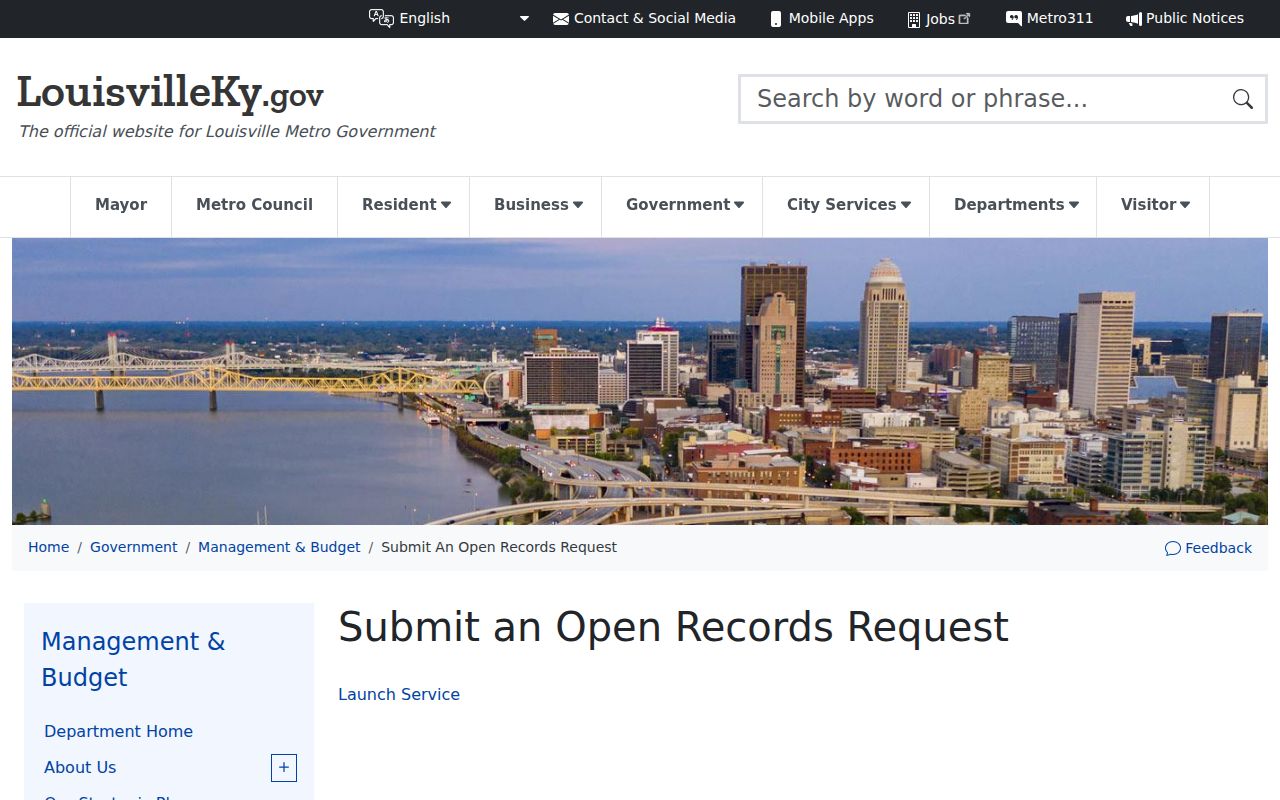
This route reaches executive-branch records, not signed Jefferson court files, which must come from the clerk.
Arrests and Bookings in Louisville
An LMPD arrest may create an agency report, an LMDC booking, an initial court record, and a fingerprint-supported state history. Louisville Metro Corrections operates the Main Jail at 400 South Sixth Street, Louisville, KY 40202. Inmate information is available at 502-574-8477. The jail, not the sheriff, creates the Louisville booking record.
A current result may show custody status, booking date, booked charges, bond, next court date, and courtroom. These are intake and custody facts, not a conviction. When the roster is unavailable or the person has been released, call LMDC or request older booking history through Metro NextRequest. The filed charge and final result belong in the Jefferson court case.
For broader county-level detail, the contextual Jefferson County arrest history resource explains how LMDC, VINE, KOOL, and court records differ. Louisville users should still keep the city altitude clear: LMPD holds its report, LMDC holds the booking, and the clerk holds the prosecution file.
Louisville Booking Records Move Downtown
The Main Jail and Hall of Justice are part of one downtown justice campus but remain separate record systems. The jail opened in 1999 after an older building was expanded. It has four levels and a secure corridor to the Hall of Justice fourth floor. That physical link helps explain why custody and first court activity can occur close together while their records remain under different custodians.
Someone checking a recent Louisville arrest should note the booking date, charge, bond, next appearance, and courtroom, then use those clues in Guest CourtNet. A missing current inmate result does not erase the booking. Release, transfer, portal timing, or search terms may account for the gap. The official case file provides the charge as filed and each later disposition.
Louisville Municipal Court Records
Louisville has no municipal court. Kentucky abolished that local court layer, so traffic matters, misdemeanors, violations, ordinance cases, and felony preliminaries go to Jefferson District Court. Indicted felonies go to Jefferson Circuit Court. Calling either one a Louisville municipal court record would misstate where the legal file is kept.
| Court Name | Jefferson District Court or Jefferson Circuit Court, depending on case level. |
|---|---|
| Case Types Heard | District handles traffic, misdemeanors, violations, ordinance matters, and felony preliminaries; Circuit handles indicted felonies. |
| Case Lookup Channel | Guest CourtNet for public case data; Circuit Court Clerk for the official file. |
| What the Docket Shows | Case number, status, charges, events, hearing data, disposition, and sentencing fields when public. |
| Copies and Fees | Request from the proper clerk counter; no current official copy schedule was confirmed in research. |
District Criminal and Traffic functions are at the Louis D. Brandeis Hall of Justice, 600 West Jefferson Street. Circuit matters are served at the Jefferson County Judicial Center, 700 West Jefferson Street.
Louisville Criminal Records and the Balance
The official population figure used for Louisville is the Census consolidated-government balance, estimated at 641,962 residents on July 1, 2025. “Balance” is a geographic term. It describes the merged Louisville/Jefferson County government area after excluding separately incorporated places within the county. It should not be read as the population of every incorporated city under one police jurisdiction.
This geography matters for Louisville criminal records. LMPD handles most incidents in the balance, but Jeffersontown, St. Matthews, and other home-rule cities retain police agencies. Booking commonly centralizes at LMDC and prosecution centralizes in Jefferson courts, even when the first report remains with a suburban department. Confirm the arresting agency before filing a Louisville request.
Where Louisville Records End Up
A Louisville event moves through agencies as decisions are made. LMPD documents the reported incident and any arrest. LMDC adds a booking if a person enters jail. The County Attorney handles District prosecution, while the Commonwealth's Attorney handles felony prosecution in Circuit Court. Courts report dispositions into Kentucky's records structure.
Record flow: Louisville Metro Police Department › Jefferson County Courts › Kentucky State Police
The flow is not a promise that each database updates at once. Search LMPD or LMDC for the newest local event, Jefferson courts for filed charges and outcomes, and the appropriate statewide product for broader coverage. AOC FastCheck is a CourtNet-based report marked “Not an Official Court Record.” KSP's fingerprint-supported system is different and is not open as a public name-search rap sheet.
Louisville Criminal Records Across City Lines
The Ohio River, the downtown I-64, I-65, and I-71 interchange, and the I-264 and I-265 beltways shape where agencies respond. Large Derby and Fairgrounds events can involve city, university, state, or other public-safety agencies. The place name “Louisville” alone does not prove LMPD created a particular record.
Use the incident location and agency name on any citation, report number, booking result, or court docket. University of Louisville Police, for example, keeps its own report channel and Clery crime log. An LMPD request cannot compel another agency to produce its file. The Louisville criminal history trail may still converge at LMDC and Jefferson courts after the first agency record is made.
Public Access Rules
Kentucky law permits residents to request existing nonexempt public records, but access depends on the custodian and record status. Active enforcement material, protected victim or witness data, juveniles, medical details, personal identifiers, and sealed or expunged records may be withheld. A partial exemption can support redaction rather than withholding every separable part.
Key Statutes:
KRS 61.872 provides the written inspection route for nonexempt records under the Kentucky Open Records Act.
KRS 61.878 supplies privacy and enforcement exemptions that can limit a Louisville police disclosure.
KRS 17.150 addresses completed investigative files and redactions while keeping centralized KSP history outside ordinary public inspection.
Judicial records follow the court's access route, not Metro's executive open-records portal. A denial should state the legal basis and explain its application to the requested Louisville record.
Louisville Police Records and Reform
The December 2024 consent decree created a court-enforceable reform framework for force, de-escalation, investigations, supervision, training, accountability, and data. It is useful Louisville context because policy, audit, complaint, and implementation records may document agency change without proving anything about a person in a criminal case.
The official Justice Department source is shown below.
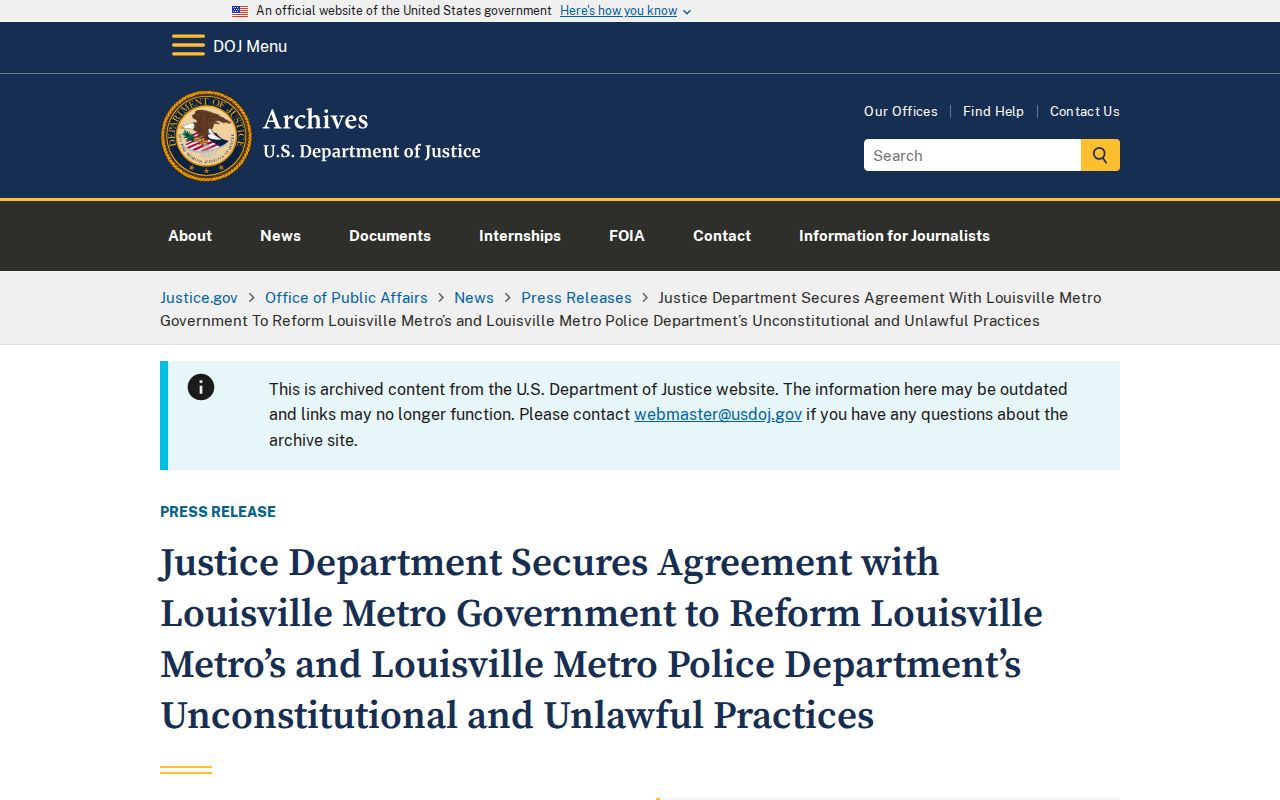
The image connects Louisville police-record research to the primary reform source rather than an unsupported summary. Separate 2025 Inspector General reporting discussed officer-involved shooting reviews, complaint allegations, and data limits. Those oversight records belong in their own context and do not replace an LMPD report, LMDC booking, or Jefferson court file.